
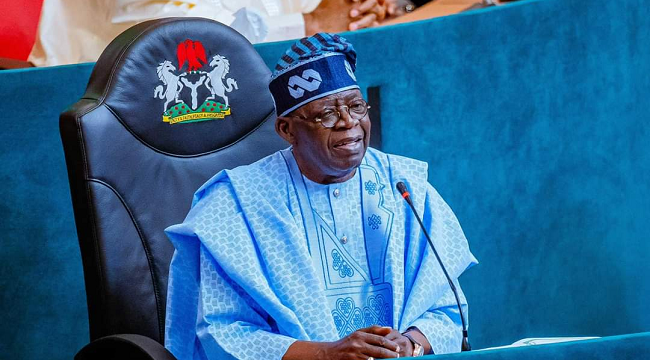
President Bola Tinubu has urged Nigerian banks to translate the recently concluded recapitalisation exercise into affordable credit for businesses, warning that stronger balance sheets would have limited value if productive sectors remain starved of financing.
President Tinubu spoke on Tuesday at the 19th Annual Banking and Finance Conference of the Chartered Institute of Bankers of Nigeria in Abuja. He was represented by the Minister of Finance and Coordinating Minister of the Economy, Taiwo Oyedele.

The President said the financial sector must move beyond financing government to supporting businesses, investment and job creation.
“A resilient banking system cannot exist indefinitely where businesses cannot obtain affordable credit, manufacturing that is struggling cannot expand, and millions of productive MSMEs remain outside of the formal financial system,” he said.
He added that the recapitalisation must lead to increased financing of the real economy, particularly Nigerian businesses expanding across Africa.
“A bigger bank that does not finance a more productive economy is a sub-optimal outcome,” President Tinubu said.
He said the government was expanding guarantees, risk-sharing, blended finance and credit-enhancement mechanisms through the National Credit Guarantee Company to reduce lending risks to productive sectors.
President Tinubu also said the government would gradually create more room for private-sector lending as fiscal conditions improve, noting that attractive returns on government securities had previously discouraged lending to businesses.
Meanwhile, UBA Group CEO and Chairman of the Body of Bank CEOs, Oliver Alawuba, said banks raised N6.4tn through the recapitalisation exercise.
He said the strengthened capital base should now be converted into affordable credit for MSMEs, agriculture, manufacturing, infrastructure and exports.
CIBN President and Chairman of Council, Dele Alabi, said 33 banks had met the revised minimum capital requirements by March 2026, raising about N4.65tn, with 72 per cent coming from domestic investors.
World Bank Country Director for Nigeria, Mathew Verghis, said credit remained concentrated away from sectors that generate significant employment, noting that MSMEs receive about one per cent of domestic credit while agriculture gets about six per cent.
CBN Governor Olayemi Cardoso, represented by Deputy Governor Philip Ikeazor, said the recapitalisation demonstrated the depth of Nigeria’s domestic capital market, but acknowledged concerns over when ordinary Nigerians would feel the benefits of improving economic conditions.
“The question that remains on everyone’s mind is, when will the common man feel the full benefits? That is on its way,” Cardoso said.