
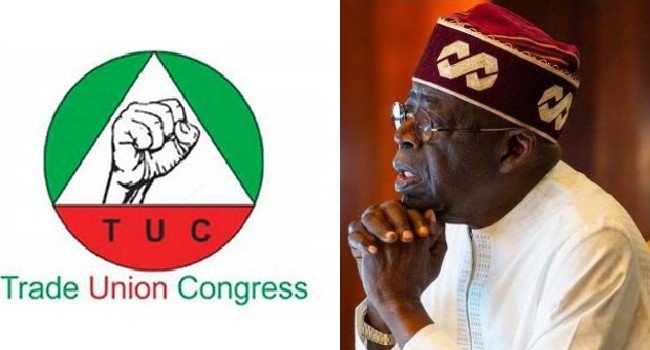
The Trade Union Congress of Nigeria (TUC) has rejected President Bola Tinubu’s ₦70,000 transportation allowance for workers over six months, demanding immediate salary increases and full implementation of the agreement with the Joint Health Sector Unions (JOHESU).
President Tinubu announced the intervention on Tuesday following a conciliation meeting with the Nigeria Labour Congress (NLC), with the allowance scheduled to begin in November 2026.

However, the TUC said temporary relief measures were inadequate to address the economic hardship facing workers and the wider population.
In a statement following its National Administrative Council meeting in Abuja on October 8, the union said it had written to the Federal Government, requesting an immediate salary review rather than temporary interventions.
The TUC argued that the government could increase the salaries of the lowest-paid workers to ₦300,000 from the current ₦70,000, citing some states that have raised their minimum wages above ₦100,000.
It maintained that the government did not need to wait for a new minimum wage negotiation before increasing workers’ pay, noting that there was no legal ceiling on wages.
The union also questioned the proposed return to temporary wage awards, saying the previous ₦40,000 award agreed upon in October 2023 was not fully implemented before the 2024 minimum wage agreement.
According to the TUC, some workers received only one or two months of the award, while others received none. It further claimed that more than 80 per cent of states and the informal sector did not implement any form of wage award.
The congress said salary increases remained the most reliable and far-reaching means of improving workers’ welfare, particularly amid rising food, transportation and healthcare costs.
It called on federal, state and local governments to ensure timely payment of salaries and pensions, protect existing jobs, curb exploitative labour practices and introduce measures to reduce the cost of essential goods and services.
TUC Demands Implementation of JOHESU Agreement
The union also accused the Federal Government of failing to implement the agreement reached with JOHESU to resolve the health workers’ prolonged industrial action.
According to the TUC, a final conciliation meeting involving government officials and organised labour produced a communiqué under which outstanding issues relating to the Consolidated Health Salary Structure (CONHESS) adjustment were to be resolved without further delay.
The union said JOHESU suspended its strike in good faith, but the agreed salary adjustment remained unimplemented seven months later.
It described the delay as a breach of the agreement, arguing that it undermined confidence in collective bargaining.
The TUC called on the Federal Government to implement the CONHESS adjustment immediately, provide the necessary budgetary provisions, publish a clear implementation timetable and resolve all outstanding issues in consultation with the relevant unions.
It warned that it would pursue lawful measures to compel the government to honour its commitments to health workers.
The congress said it was awaiting the outcome of a scheduled meeting with the government before deciding its next line of action, insisting that workers’ welfare, social protection and compliance with agreements must take priority over temporary relief measures.