
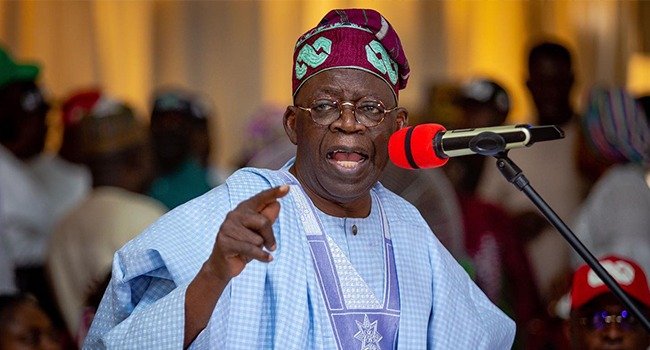
President directs South African delegation to engage Minister of State for Foreign Affairs amid diplomatic tensions.
President Bola Tinubu on Monday declined to receive a special delegation from South African President Cyril Ramaphosa over the ongoing xenophobic attacks on Nigerians in South Africa, directing the visiting envoys to instead meet with the Minister of State for Foreign Affairs, Ambassador Sola Enikanolaiye.
Presidency sources confirmed that the delegation, led by South Africa’s Minister of International Relations and Cooperation, Ronald Lamola, arrived in Abuja on Friday seeking an audience with the President but was redirected to the Foreign Affairs Ministry.

According to a Presidency source, the delegation had initially requested to meet President Tinubu upon arrival without prior notice and was asked to return on Monday. However, the President later directed that discussions be held with the Minister of State for Foreign Affairs.
“The President said they should meet with Ambassador Enikanolaiye, who would brief him on the outcome of their discussions,” the source disclosed.
The development comes amid growing diplomatic tensions between Nigeria and South Africa following renewed xenophobic attacks targeting Nigerians and other African nationals, which have forced the evacuation of nearly 600 Nigerians back home.
Receiving the delegation in Abuja, Enikanolaiye said Tinubu mandated him to engage the South African envoys on finding lasting solutions to the crisis.
“President Bola Tinubu has asked us to exchange views and perspectives on how to address and resolve the ongoing Afrophobic attacks in South Africa, of which Nigerians and other African citizens have been victims,” he said.
The minister lamented the recurring attacks on Nigerians, noting that similar incidents were recorded in 1995, 1998, 2006, 2015, 2016, 2019, 2021, 2024 and 2026.
He disclosed that from 2022 alone, at least 98 Nigerians have died in mob and hate-related attacks in South Africa, stressing that Nigeria does not support criminality but insists that accused persons must be treated in accordance with the law.
“If someone is accused of drug trafficking or any offence, there are legal processes for arrest, prosecution and punishment. What we reject is mob justice and attacks on innocent Nigerians legally residing in South Africa,” he said.
Enikanolaiye also recalled Nigeria’s historic support for South Africa during the anti-apartheid struggle, describing the attacks as inconsistent with the longstanding relationship between both nations.
He further revealed that Nigeria had previously evacuated nearly 1,500 citizens from South Africa, describing the humanitarian consequences of the attacks as devastating.
Responding, Lamola said President Ramaphosa sent him as a special envoy to reaffirm South Africa’s opposition to xenophobia, racism and all forms of intolerance.
“We have been outspoken against xenophobia, racism, homophobia, violence and discrimination directed at individuals within our borders,” he said.
He, however, maintained that South Africa would continue to enforce its immigration laws and tackle criminal activities within its territory.
Lamola noted that migration remains a continental challenge requiring collective African solutions and expressed optimism that sustained dialogue between both countries would strengthen bilateral relations and help resolve the crisis.
Relations between Nigeria and South Africa have deteriorated in recent weeks following renewed xenophobic violence that erupted across several South African provinces in April 2026.
The crisis prompted President Tinubu to approve five evacuation flights for stranded Nigerians after more than 1,000 citizens registered for voluntary repatriation. Nigeria has also warned that retaliatory diplomatic measures remain an option, while the National Assembly has recommended actions against South African business interests operating in the country.
Lamola’s visit is believed to be part of Ramaphosa’s efforts to de-escalate tensions ahead of the African Union Extraordinary Summit on Conflict Prevention and Resolution scheduled to hold in Angola from August 29 to 30, 2026.