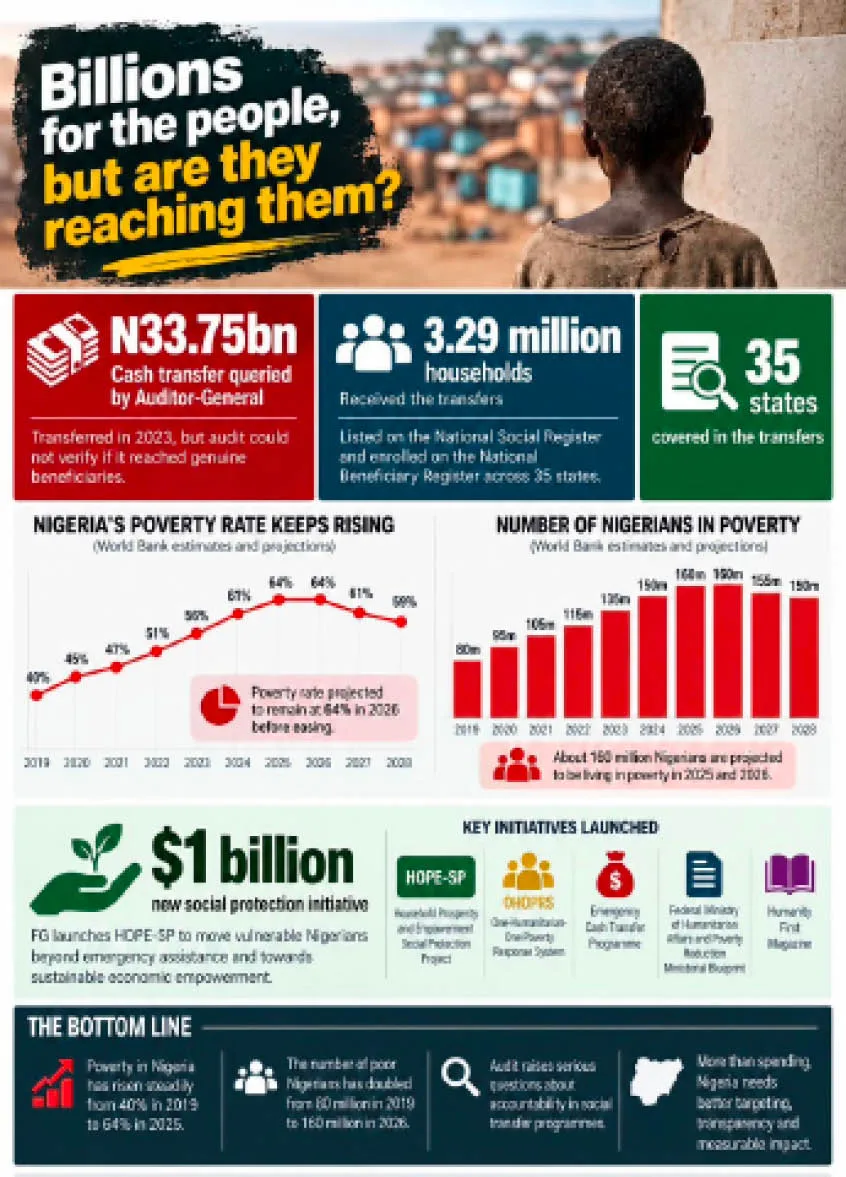
Fresh concerns have emerged over the Federal Government’s recently launched $1bn social protection programme following an audit query over N33.75bn in cash transfers made to more than 3.29 million households in 2023.
The Auditor-General for the Federation raised the concerns in the 2024 Annual Report on Non-Compliance and Internal Control Weaknesses in Ministries, Departments and Agencies, which reviewed transactions of the National Cash Transfer Office in Abuja for the 2023 financial year.

According to the report, N33.751bn was electronically transferred to 3,295,207 households and beneficiaries listed on the National Social Register and National Beneficiary Register across 35 states.
However, auditors said the National Cash Transfer Office failed to provide adequate records to establish the identities of recipients or reconcile the payments with the official registers.
The report said payment vouchers lacked complete beneficiary details, while the office failed to provide a Remita statement showing those who actually received the funds.
“This hindered the authentication of the payments and made it difficult to ascertain whether the beneficiaries who received the funds were genuine,” the auditors said.
The auditors further alleged that NCTO accounts staff obstructed attempts to obtain the Remita records, stating, “All efforts to obtain access to the REMITA statement were obstructed and denied by NCTO accounts staff, thereby frustrating the audit process.”
The findings were said to be contrary to the Financial Regulations 2009, particularly provisions requiring payment vouchers to contain sufficient details and supporting documents to enable verification.
The development comes as the Federal Government has launched the $1bn Household Prosperity and Empowerment Social Protection Project, alongside other programmes aimed at strengthening poverty reduction and humanitarian interventions.
The concerns also revive earlier questions over the credibility of the National Social Register. State governors had called for its replacement in 2023, while the then Permanent Secretary in the Ministry of Humanitarian Affairs, Sani Gwarzo, acknowledged that although the register might not be fully accurate, it could serve as a starting point for improvement.
In January 2024, President Bola Tinubu suspended programmes administered by the National Social Investment Programme Agency amid investigations into alleged corruption in the Ministry of Humanitarian Affairs and Poverty Alleviation.
Poverty Rate Rises
The World Bank has also reported a sharp increase in Nigeria’s poverty rate, estimating that it reached about 64 per cent in 2025 and could remain at the same level in 2026 before gradually declining.
The bank, in its April 2026 Nigeria Development Update, projected that poverty would fall to 61 per cent in 2027 and 59 per cent in 2028 as inflation eases and economic growth improves.
It projected average real GDP growth of 4.2 per cent between 2026 and 2028, supported by increased public investment, improved investor sentiment and structural reforms.
Expert, CSO Demand Accountability
Development expert and Executive Director of the Centre for Fiscal Transparency and Public Integrity, Dr Umar Yakubu, said the audit findings exposed what he described as “institutionalised impunity” in the management of public funds.
Yakubu called for technology-driven oversight, stronger transparency measures and independent verification of beneficiaries, warning that social intervention programmes should not become conduits for unverified expenditure.
Similarly, the International Society for Social Justice and Human Rights demanded full disclosure and an independent forensic audit of the N33.7bn transfers before the government commits additional funds to the new $1bn programme.
Its Chancellor, Dr Jackson Omenazu, said, “If public money cannot be independently audited, Nigerians have a legitimate right to ask: who is accountable for the money and where did it go?”
The organisation called for publication of beneficiary and payment details, unrestricted access for the Auditor-General and other oversight bodies, and the suspension of further disbursements until the outstanding accountability concerns are resolved.