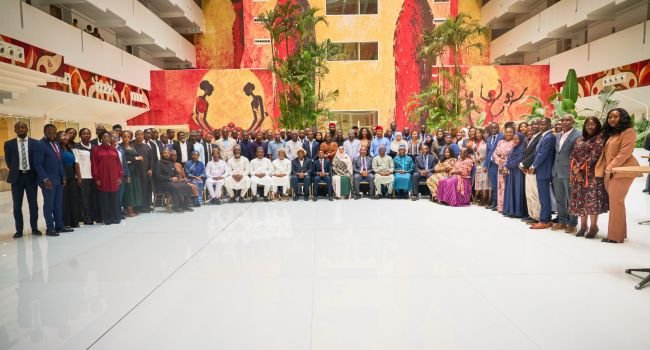
Nigeria has commenced a five-day capacity-building programme for 100 members of its Mutual Evaluation Working Groups to strengthen preparations for the country’s third-round assessment on anti-money laundering, counter-financing of terrorism and counter-proliferation financing.
The training, running from October 12 to 16, 2026, in Abuja, is being facilitated by the Inter-Governmental Action Group against Money Laundering in West Africa (GIABA), with support from SecFIN Africa, following Nigeria’s request.
Speaking at the opening, Nigerian Financial Intelligence Unit (NFIU) Chief Executive Officer, Hafsat Abubakar Bakari, said the country must demonstrate not only the strength of its laws and institutions but also their effectiveness in combating financial crime.
She said the programme builds on Nigeria’s exit from the Financial Action Task Force (FATF) grey list in October 2025 and would prepare participants for a national mock mutual evaluation exercise scheduled for November 2026.
The training brings together representatives of key institutions, including the Central Bank of Nigeria, Economic and Financial Crimes Commission, Independent Corrupt Practices and Other Related Offences Commission, Federal Ministry of Justice, Nigeria Police Force, Department of State Services and Nigeria Customs Service.
Sessions will cover financial intelligence, regulatory supervision, virtual assets, beneficial ownership, investigations and prosecutions, asset recovery, international cooperation, targeted financial sanctions and proliferation financing risks. Participants will also take part in simulated assessment interviews to improve their ability to provide accurate information and verifiable evidence.
The NFIU said Nigeria had increased its pool of accredited global experts on FATF standards from fewer than 10 to 25 over the past two years. It added that further training cohorts of 100 to 150 participants were planned quarterly, with possible future expansion to the private sector.
The initiative forms part of broader efforts to identify gaps, strengthen inter-agency coordination and demonstrate measurable progress ahead of Nigeria’s next mutual evaluation.