
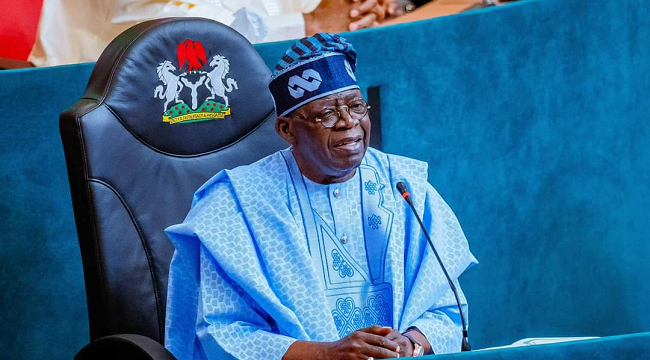
President Bola Tinubu has said his administration is rewriting Nigeria’s long-standing story of economic underperformance, citing improvements in gross domestic product (GDP) growth, capital inflows and manufacturing.
President Tinubu, represented by Vice President Kashim Shettima, spoke on Monday while declaring open the 32nd Nigerian Economic Summit in Abuja, themed “Growth That Works: Delivering Jobs, Productivity and Shared Prosperity.”

Details of the President’s address were contained in a statement by Stanley Nkwocha, Senior Special Assistant to the Vice President on Media and Communications.
President Tinubu said his administration had embarked on difficult economic reforms to remove structural barriers to growth, attract investment and create productive employment.
“We came to rewrite the story of a nation that has performed below its potential for far too long. But there is no shortcut to economic growth,” the President was quoted as saying.
He said the reforms were intended to improve livelihoods and expand opportunities for young jobseekers, farmers, manufacturers, entrepreneurs and innovators.
Citing figures from the National Bureau of Statistics, President Tinubu said Nigeria’s inflation-adjusted GDP grew by 3.89 per cent in the first quarter of 2026, compared with 3.13 per cent in the corresponding period of 2025.
He added that non-oil activities accounted for 96.08 per cent of GDP during the period, while manufacturing grew by 3.29 per cent and the oil sector by 2.57 per cent.
The President also disclosed that capital importation reached $10.37bn in the first quarter of 2026, representing an 83.83 per cent increase compared with the same period in 2025. He said the inflows comprised portfolio and foreign direct investments.
President Tinubu pledged to continue easing regulatory burdens, improving transparency and policy predictability, and expanding access to finance.
However, he acknowledged that significant work remained, particularly in electricity market reforms, agricultural value chains and the development of the solid minerals sector through domestic processing rather than raw extraction.
The United Nations Deputy Secretary-General, Amina Mohammed, acknowledged the gains recorded under the reforms but called for their urgent consolidation and stabilisation. She also urged careful management of public expectations.
Meanwhile, the Minister of Finance and Coordinating Minister of the Economy, Taiwo Oyedele, presented a draft Nigerian Economic Policy Framework, describing it as a national economic doctrine built around enterprise, open but fair markets and coordinated government action.
Oyedele invited the Nigerian Economic Summit Group (NESG) and private-sector experts to scrutinise the proposed framework and contribute evidence-based feedback.
NESG Chairman Olaniyi Yusuf said the priority should be to stabilise the reforms rather than reverse them.
BUA Group Chairman Abdul Samad Rabiu also commended improvements in access to foreign exchange, recalling that businesses previously struggled to obtain the foreign currency needed to import raw materials and machinery, even when they had sufficient naira.
Governors Chukwuma Soludo of Anambra State and Babajide Sanwo-Olu of Lagos State attended the opening session alongside several cabinet members, including Abubakar Bagudu, Jumoke Oduwole, Idi Mukhtar Maiha and Doris Uzoka-Anite.
President Tinubu introduced major economic changes shortly after assuming office in May 2023, including removing the petrol subsidy and unifying the naira’s multiple exchange rates.
While the measures have been associated with improved foreign exchange access and increased capital inflows, they have also been followed by a sharp rise in inflation and a cost-of-living crisis that has placed pressure on households and businesses.
The Nigerian Economic Summit, established in 1993, remains a major platform for dialogue between the public and private sectors on the country’s economic policies and development priorities.