
President urges universities to turn research findings into practical solutions and equip students with skills for the future economy.
President Bola Tinubu has charged Nigerian universities to reposition themselves as engines of research, technological innovation and economic development by translating academic findings into practical solutions.
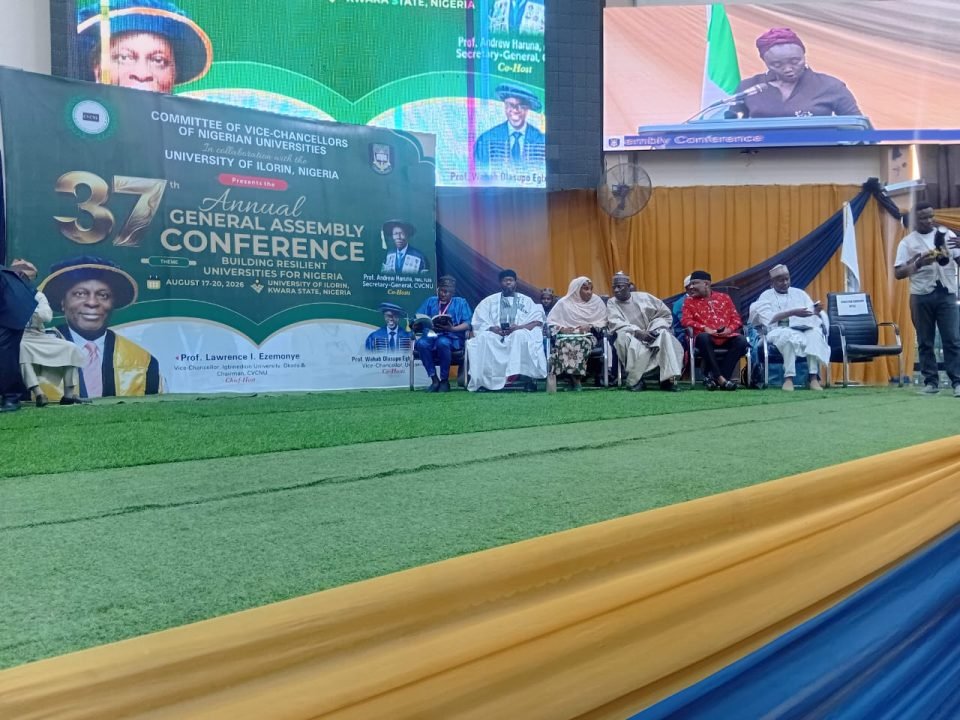
President Tinubu, represented by the Minister of State for Education, Prof. Suwaiba Ahmad, gave the charge at the 37th General Assembly of the Committee of Vice-Chancellors of Nigerian Universities (CVCNU), hosted by the University of Ilorin, with the theme, “Building Resilient Universities for Nigeria.”

The President stressed the need for effective university governance anchored on transparency, accountability, efficiency, academic freedom and responsible management of public resources.
He urged universities to create pathways for young Nigerians to acquire relevant skills and transform innovative ideas into viable businesses, while strengthening partnerships with government, industry, development partners and local communities.
President Tinubu said such partnerships should focus on critical sectors including agriculture, healthcare, energy, transportation, manufacturing, environmental sustainability, security and digital technology.
He also disclosed that curriculum reforms had commenced, beginning with agriculture, to make university education more practical and responsive to labour-market demands. He said internships, industry partnerships and work-based learning would help improve graduate employability.
The Executive Secretary of the National Universities Commission (NUC), Prof. Abdullahi Ribadu, announced plans to launch Blueprint 2.0, a 13-point roadmap aimed at revitalising university education through continuous monitoring, evaluation and periodic adjustments.
In his address, the President of CVCNU, Prof. Lawrence Ezemonye, said Nigerian universities were facing funding challenges, industrial unrest, demographic pressures, technological disruptions and the migration of highly skilled academics.
He called for urgent and courageous measures to strengthen the resilience of the institutions.
Also speaking, immediate past Registrar of the Joint Admissions and Matriculation Board (JAMB), Prof. Is’haq Oloyede, urged universities to place greater emphasis on the practical application of knowledge, warning that academic qualifications and theoretical learning alone would not be enough to transform society in the era of artificial intelligence and expanding digital media.