
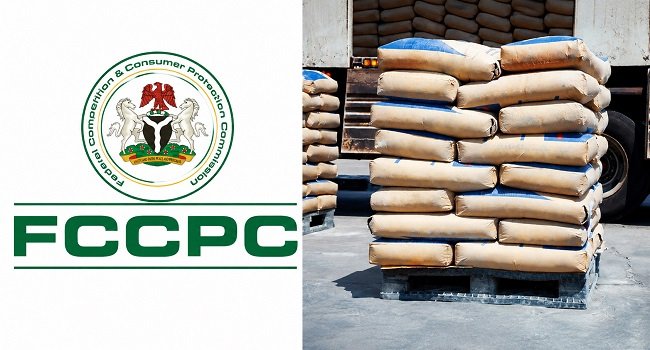
Regulator flags sharp price increases and market concentration as investigation examines possible anti-competitive practices.
The Federal Competition and Consumer Protection Commission (FCCPC) has raised concerns over possible price manipulation and other anti-competitive practices in Nigeria’s cement industry following preliminary findings from an ongoing investigation.
The findings are contained in a 40-page field report by the commission’s Anticompetitive Practices Department after a three-month assessment of cement markets in Nigeria and six other African countries.

The FCCPC said the investigation was triggered by concerns over the rising cost of cement despite Nigeria’s substantial limestone deposits, significant domestic production capacity and reported excess installed capacity.
According to the commission, cement prices rose from between N9,300 and N9,700 per bag in January 2026 to between N10,500 and N13,000 by mid-year, with prices reaching N13,000 to N15,000 in some areas by July.
The regulator estimated Nigeria’s installed cement production capacity at more than 60 million to 65 million metric tonnes annually, compared with domestic consumption of about 25 million to 30 million metric tonnes.
It said the country’s status as a net exporter of cement and the wide gap between production capacity and domestic consumption raised questions about why excess capacity had not translated into lower prices.
The FCCPC compared Nigeria’s cement market with those of Kenya, Tanzania, South Africa, Egypt, Morocco and Algeria. It said a 50kg bag of cement sold for about N7,344 in Nairobi and N6,528 in Tanzania, while the price in Togo was about N9,180.
Industry operators attributed the high prices in Nigeria to factors including energy costs, naira depreciation, imported machinery and spare parts, transportation and logistics expenses.
The commission said it was testing those explanations against verified information on production costs, pricing and prevailing market conditions.
The next phase of the investigation will determine whether current cement prices are justified by legitimate costs or whether there is evidence of coordinated conduct, abuse of market power, restrictions on domestic supply or other violations of the Federal Competition and Consumer Protection Act.
The FCCPC said it had issued investigation notices and summonses to major industry players, directing them to submit records covering pricing methods, production, capacity utilisation, exports and commercial relationships.
FCCPC Executive Vice-Chairman and Chief Executive Officer, Tunji Bello, said the probe was necessary because cement prices directly affect housing, infrastructure development and the broader cost of doing business.
Bello stressed that the investigation was not intended to control legitimate business decisions but to establish whether competition in the cement market was functioning effectively and protecting consumers.