
President Tinubu seeks second term as inflation, cost-of-living pressures, insecurity and a divided opposition shape the race.
Political campaigns for Nigeria’s 2027 general elections officially begin on Wednesday, with President Bola Tinubu’s economic reforms, rising living costs and persistent insecurity expected to dominate the contest.
President Tinubu, who is seeking a second term on the platform of the All Progressives Congress (APC), has defended his administration’s economic reforms, including the removal of fuel subsidy, which economists and investors have praised but which has also contributed to significant cost-of-living pressures.

Although headline inflation has recently eased, millions of Nigerians continue to face economic hardship, while insecurity remains a major concern across several parts of the country.
Security challenges include jihadist insurgency in the North-East, banditry in the North and central regions, farmer-herder conflicts and separatist violence in the South-East.
The 2027 presidential race is expected to feature a rematch of the 2023 contest, with Tinubu facing major opposition figures including Peter Obi and former Vice President Atiku Abubakar. Rabiu Kwankwaso, who finished fourth in 2023, has also aligned politically with Obi.
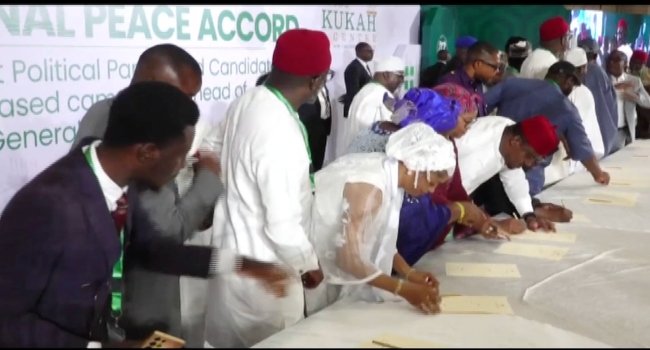
The campaign season began shortly after major presidential candidates and political actors signed the National Peace Accord in Abuja on Tuesday.
The accord, organised by the National Peace Committee, commits political parties and candidates to peaceful and issue-based campaigns before, during and after the elections.
Speaking at the signing ceremony, Obi called for credible and violence-free elections, urging Nigerians to reject candidates who violate the principles of the agreement.
President Tinubu, represented at the event by Secretary to the Government of the Federation George Akume, reaffirmed the commitment of the APC to peaceful elections and condemned electoral violence, hate speech, misinformation and incitement.
He also cited recent off-cycle elections, including those in Anambra, Osun and Ekiti, as evidence of improved transparency in Nigeria’s electoral process, attributing the progress partly to technologies such as the Bimodal Voter Accreditation System (BVAS).
The Independent National Electoral Commission (INEC) has also promised to conduct credible elections, with its Chairman, Joash Amupitan, insisting that the commission has no preferred candidate or political party.
With campaigns now underway, the 2027 election is set to test the government’s economic record, the opposition’s ability to unite and the capacity of political actors and security agencies to deliver peaceful and credible polls.