
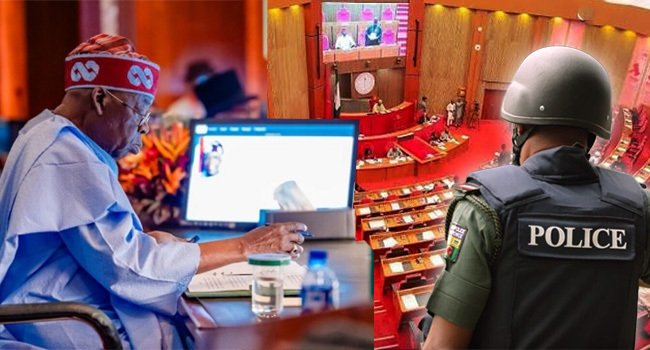
Proposed constitutional amendment aims to create a dual policing system, allowing states to establish and operate their own police forces.
President Bola Tinubu has formally transmitted a Constitution Alteration Bill to the Senate seeking the establishment of state police, marking a major step in efforts to reform Nigeria’s security architecture.
The proposed legislation, contained in a communication dated June 15, 2026, was read during plenary by Senate President, Godswill Akpabio.

According to the President, the bill is intended to provide a constitutional framework for a dual policing structure that will allow states to establish and manage their own police services alongside the Nigeria Police Force.
President Tinubu said the proposal forms a key part of ongoing efforts to strengthen security nationwide, improve community policing, and enhance the protection of lives and property.
Following its presentation, the Senate referred the bill to the Senate Committee on Constitutional Review for further legislative consideration, with a directive to report back to the chamber.
Speaking on the development, Akpabio stressed the importance of community-based security, noting that local authorities are often better positioned to identify suspicious activities and emerging threats within their communities.
He explained that the implementation of state policing would be carried out through constitutional amendments and supporting legislation, with safeguards put in place to prevent abuse and ensure accountability.
“We will do it in two phases through alteration and an Act of Parliament. There will be a lot of safeguards,” Akpabio said.
The Senate President also urged lawmakers to attend subsequent sittings, emphasizing that constitutional amendments require the support of at least two-thirds of members.
According to him, the issue of state police transcends partisan politics and regional interests, describing it as a national security matter that requires broad consensus.
The latest move comes weeks after the Senate passed an executive bill on state police for second reading, signaling growing momentum behind calls for decentralised policing as Nigeria continues to confront security challenges across different parts of the country.